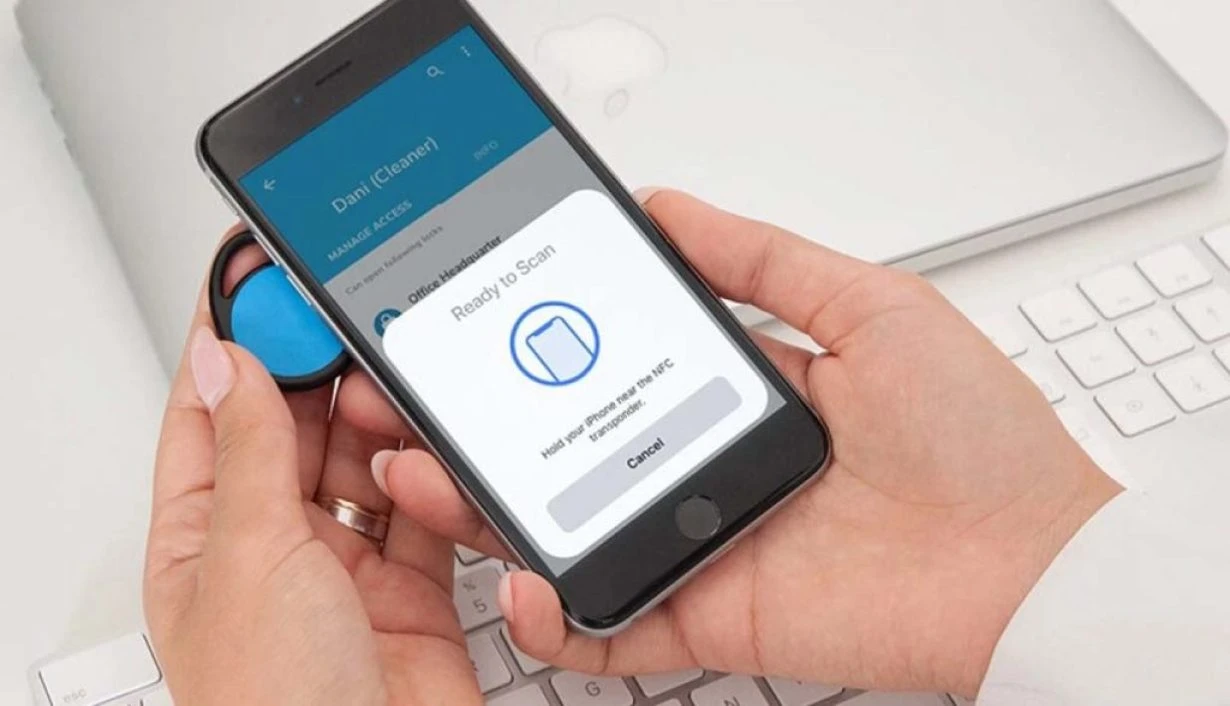
RFID vs Barcode: What Are They?
The two most common methods for automating inventory tracking, asset management and logistics are RFID (Radio Frequency Identification) and traditional barcodes scanned by handheld or fixed barcode scanners.
- RFID uses micro‑chips embedded in “tags” that communicate via radio waves with “readers.” Tags can be passive (no battery, powered by reader signal) or active (with their own power source), and data stored on the tag can include unique IDs, metadata, and — for some tags — updatable information such as product history, maintenance records, expiry dates, etc.
- Barcodes, by contrast, are optical labels (printed lines/QR codes) that encode simple data (usually a product or item ID). A barcode scanner must “see” the code (line‑of‑sight) to read it; data encoded is fixed and rarely more than a basic identifier.
Because of these fundamental differences in how they work, RFID and barcode systems each have strengths and weaknesses — making them suited to different business cases.
Key Advantages of RFID Handheld Readers
● Batch / Bulk Scanning & Speed
RFID excels in environments where many items need to be scanned at once — for example, a warehouse, distribution center, or logistics hub. Unlike barcode scanners, which scan items individually, an RFID reader can “see” and capture multiple tags at once, even when they’re packed together, stacked, or inside boxes.
This significantly reduces the time and labour involved, especially in high-volume operations (e.g. inventory audits, goods receipt, stock counts).
● No Line‑of‑Sight Required
Because RFID relies on radio waves rather than optical scanning, the reader does not need a direct view of the tag. Tags can be “hidden” behind packaging, inside crates or containers, or even partially obscured.
This is particularly useful in warehouse, manufacturing, or logistics environments — or in Malaysia’s hot, humid, or dusty conditions — where barcodes can be damaged or obscured.
● Greater Data Capacity, Flexibility & Traceability
RFID tags can store more data than a barcode. Not only can they represent a simple ID, but in many deployments they record additional metadata — e.g. manufacturing date, batch number, maintenance history, expiry date, location data, etc.
Many RFID tags are also rewritable or support updating — enabling dynamic tracking of product lifecycle, condition, and more.
This improved data richness and traceability is particularly beneficial for supply chain transparency, asset management, or U₋ high‑value goods tracking.
● Durability & Reliability in Tough Environments
RFID tags tend to be more durable than printed barcode labels. They can better withstand dirt, moisture, wear and tear — making them suitable for harsh working conditions, industrial settings, or outdoor/storage warehouses.
Thus, for Malaysian warehouses, manufacturing sites, or logistics hubs (which often deal with humidity, dust, and heavy handling), RFID may offer more reliability and lower maintenance than barcodes.
● Better for Automation, Real-Time Tracking & Large‑Scale Operations
Because RFID can quickly capture large volumes of data (multiple items, remote reading, fast scans), it is well-suited for automation: real‑time inventory updates, dynamic asset tracking, supply‑chain visibility, and integration with warehouse‑management systems or enterprise resource planning (ERP) solutions.
Industries such as retail, logistics, manufacturing, healthcare — whether in Malaysia or globally — increasingly adopt RFID for this reason.
Why Barcode Scanners (Traditional) Still Matter
✔ Low Cost & Easy Implementation
Setting up a barcode system is relatively cheap. Printing barcode labels and deploying basic scanner hardware costs far less than procuring RFID tags, readers, and associated infrastructure.
For small‑ to medium‑sized businesses in Malaysia — especially those with tight budgets — barcode scanning remains the most practical and economical option.
✔ Simplicity and Familiarity
Barcodes are a mature, widely adopted technology. Most retail outlets, small warehouses, shops, and logistics operations already know how to deploy and integrate barcode scanners with minimal training or technical overhead.
In settings where products are individually handled (e.g. retail checkout, small stockrooms, POS systems), barcode scanning remains reliable, straightforward, and “good enough.”
✔ Lower Technical Complexity and Maintenance
Barcode systems don’t require complex infrastructure, database integration, or specialized software — which often makes them easier to maintain.
If you only need basic identification — SKU tracking, point-of-sale scanning — barcodes are often the simplest, most cost‑effective solution.
Trade‑offs and Limitations: What to Watch Out For
➤ Higher Initial Investment & Complexity of RFID
RFID systems generally cost more — both in terms of tags (much pricier than barcode labels) and readers/hardware/infrastructure. Implementation may also require more technical knowledge, software integration, and possibly adjustments in warehouse layout or processes.
For small businesses or operations with limited volume, the ROI may not justify the upfront cost.
➤ Environmental & Material Constraints for RFID
RFID signals can be affected by metals, liquids, or dense packaging — which may degrade performance or cause misreads in certain contexts.
Also, depending on the frequency (LF, HF, UHF), read‑range and reliability may vary, so careful selection of tag type and system configuration is needed.
➤ Barcodes Susceptible to Wear and Manual Error
Barcode labels can get damaged — scratched, faded, torn — making them unreadable. Also, because each item must be scanned individually and manually, there’s a higher labour burden and greater chance for human error.
For high-volume operations, scanning one by one can be slow and inefficient, especially compared to bulk RFID reading.
What This Means for Malaysia (Local Context)
For businesses in Malaysia — whether manufacturing, warehousing, retail distribution, FMCG, logistics, or even asset tracking — the choice between RFID and barcode depends heavily on scale, volume, and business goals. Below are some scenarios:
- Large warehouses or logistic hubs performing frequent stocktaking, goods receipt, or distribution: RFID’s speed, bulk‑scanning, and automated tracking can dramatically reduce labour costs, errors, and time — making it well worth the investment.
- Retail outlets, small shops, smaller storage facilities or POS‑based inventory: Barcode scanners remain practical due to low cost, simple implementation, minimal technical overhead. For many “everyday” retail and SME contexts in Malaysia, barcode solutions may remain the default.
- High‑value goods, regulated industries, or environments with harsh conditions (humidity, dust, metal packaging): RFID offers better traceability, durability, and security — beneficial for electronics warehousing, manufacturing, spare‑parts management, medical equipment, etc.
- Businesses looking for long‑term scalability, automation and digital transformation: RFID system can future‑proof operations, enabling integration with ERP/WMS, real‑time inventory management, analytics, and possibly IoT — especially important as Malaysian logistics and supply‑chain industries modernise.
However, the higher initial cost and complexity of RFID implementation must be weighed carefully — especially for SMEs or cost‑sensitive operations.
Conclusion: RFID vs Barcode — It’s Not One‑Size‑Fits‑All
Neither RFID nor barcode scanning is strictly “better” in all cases. Instead, each serves different needs:
- Use barcode scanning when cost, simplicity, and small-to-medium scale are priorities — e.g. retail checkout, small inventory, POS systems.
- Use RFID handheld readers when speed, scale, durability, automation, and real‑time tracking matter — e.g. warehouse management, logistics, asset tracking, manufacturing, high‑value goods.
For many Malaysian businesses aiming to modernise supply-chain and inventory operations — especially as the country evolves toward smarter logistics and digitalisation — RFID handheld barcode reader presents attractive long-term benefits. On the other hand, barcode systems continue to serve as a dependable, low-cost solution for simpler, lower-volume needs.
Ultimately, your choice should depend on your use case, budget, volume, and long-term vision.